Qwen 4 Max review: 3 coding tests vs Opus 5.5
Qwen is probably the most important model family for AI you run on your own hardware. I said that in my last Qwen review, and it's the reason I pay attention every time Alibaba ships a new version.
So here's the awkward part of this Qwen 4 Max review: the model isn't local at all. Qwen 4 Max (officially Qwen4-Max) went generally available on 16 November 2026 as a closed-weight, API-only model. No download, no Hugging Face repo. It's the big flagship, and the flagships are the less interesting half of the Qwen story, simply because the competition up there is so strong.
I still wanted to know how good it is. So I ran it through three coding tasks against Claude Opus 5.5, my favourite coding model right now, and measured what came out.
(Also, sorry about the quiet. I've been busy and travelling for a good part of the last two months. I wrote less, and what I did write wasn't my most exciting work. I'm hoping that changes now.)
The short answer
Qwen 4 Max is a very good model. It passed every objective check I threw at it. Claude Opus 5.5 is still slightly better: it won two of my three tests on depth, and the third was a tie. But Qwen finished in less than half the time and cost roughly a thirteenth as much at API prices.
| Task | Winner | Opus 5.5 | Qwen 4 Max |
|---|---|---|---|
| Clock with exposed gears | Opus | 50 min, 309k output tokens, $9.19 | 19 min, 92k, about $0.79 |
| Self-referential quiz | Tie | 1.7 min, 9k, $0.51 | 2.5 min, 12k, about $0.08 |
| Feature-flag service | Opus | 18.5 min, 122k, $5.12 | 7.8 min, 37k, about $0.29 |
| Total | 70 min, 440k, $14.82 | 29 min, 141k, about $1.16 |
The gap is depth, not correctness. Opus verifies its own work, handles edge cases nobody asked about, and tells you what it faked. Qwen delivers the brief with fewer safety nets.
If you pay per token and your work is agent runs or front-end builds, Qwen 4 Max deserves a serious look. If you already pay for a Claude subscription, there's not much reason to switch.
What's new in Qwen 4 Max
The quick spec sheet, from Alibaba's launch post and the Model Studio docs:
| Qwen 4 Max | Qwen 3.8 Max | |
|---|---|---|
| Parameters (total / active) | 2.4T / 71B | 2.4T / about 95B |
| Input | Text, image, video | Text only |
| Context window | 1M tokens | 262K, extensible to about 1M |
| Thinking | Can be switched off | Always on |
| API price per 1M tokens (in / out) | $1.50 / $4.50 | $2 / $6 |
| Open weights | No | Yes, since 12 August |
Under the hood it's a new architecture, previewed in Qwen3.8-Flash-Next back in August. I can't judge that from the outside, only what it's like to use.
Leaner than 3.8 Max
I liked Qwen 3.8 Max. It was very good, especially at web design, and it was so slow and verbose that I barely used it. I mostly stuck with Claude, OpenAI and Grok models, and pulled Qwen in when I wanted a few more design options to compare.
Qwen 4 Max fixes a good part of that. In my runs it got through its tasks quickly and didn't ramble. The independent numbers point the same way: on Artificial Analysis, the cost per benchmark task dropped from $10.02 to $3.27 against 3.8 Max, with about 39% fewer output tokens per task, while the Intelligence Index went from 34 to 43.
It's still not a terse model by industry standards. More on that below.
The weights are closed again
This is the part that stings. In August, Alibaba released the 3.8 Max weights, the first time a Max-class Qwen was opened. With Qwen 4 Max the door is shut again. The only promise is that smaller Qwen 4 models are "coming to open source", with no dates and no licence terms.
For a flagship I'd never run at home anyway (2.4 trillion parameters is a bit much for my Mac mini), that's mostly symbolic. But symbols count when the whole appeal of the family is that you can own the weights.
Qwen 4 Max vs Opus 5.5: three coding tests
A confession first. I find it hard to test frontier models for intelligence anymore. They're all very good. Hand any of them a well-specified problem and it gets solved, so what's left to compare is vibe, speed, efficiency and judgment.
So I picked three one-shot tasks that poke at different things: one visual, one logical, one opinionated. Opus 5.5 ran in Claude Code and Qwen 4 Max ran in pi, both at xhigh effort. One run per task isn't a sample size anyone should be proud of, so read the numbers as a field report.
I didn't judge by eye, though. Every result went through scripted checks.
Test 1: a clock with an exposed gear train
The brief: a web page with an analogue clock whose gear train is visible and mechanically correct, with the right ratios and teeth that mesh.
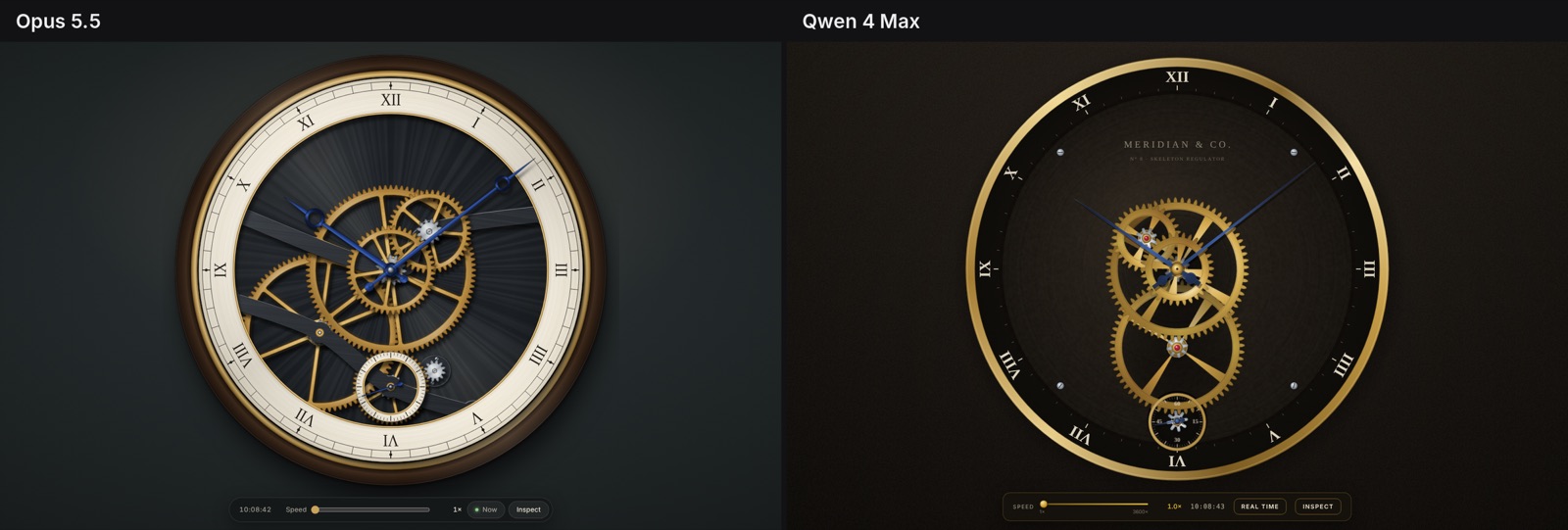
Both clocks pass everything I could measure. The ratios come out at exactly 60 and 12. I rendered both pages in headless Chrome and compared the hand angles with true time at 20,000 random moments, where the largest error was about two trillionths of a radian. A separate interference test stepped each gear mesh through 90 positions and found zero tooth overlaps on either clock.
The difference is in what I didn't ask for. Opus drew real involute teeth with a 20 degree pressure angle, so the gap between tooth flanks stays constant as the gears turn, which is what real tooth contact looks like. Qwen drew simplified trapezoid teeth. They never collide, but the gap wanders. You can't see it on screen, and Qwen says so in its notes.
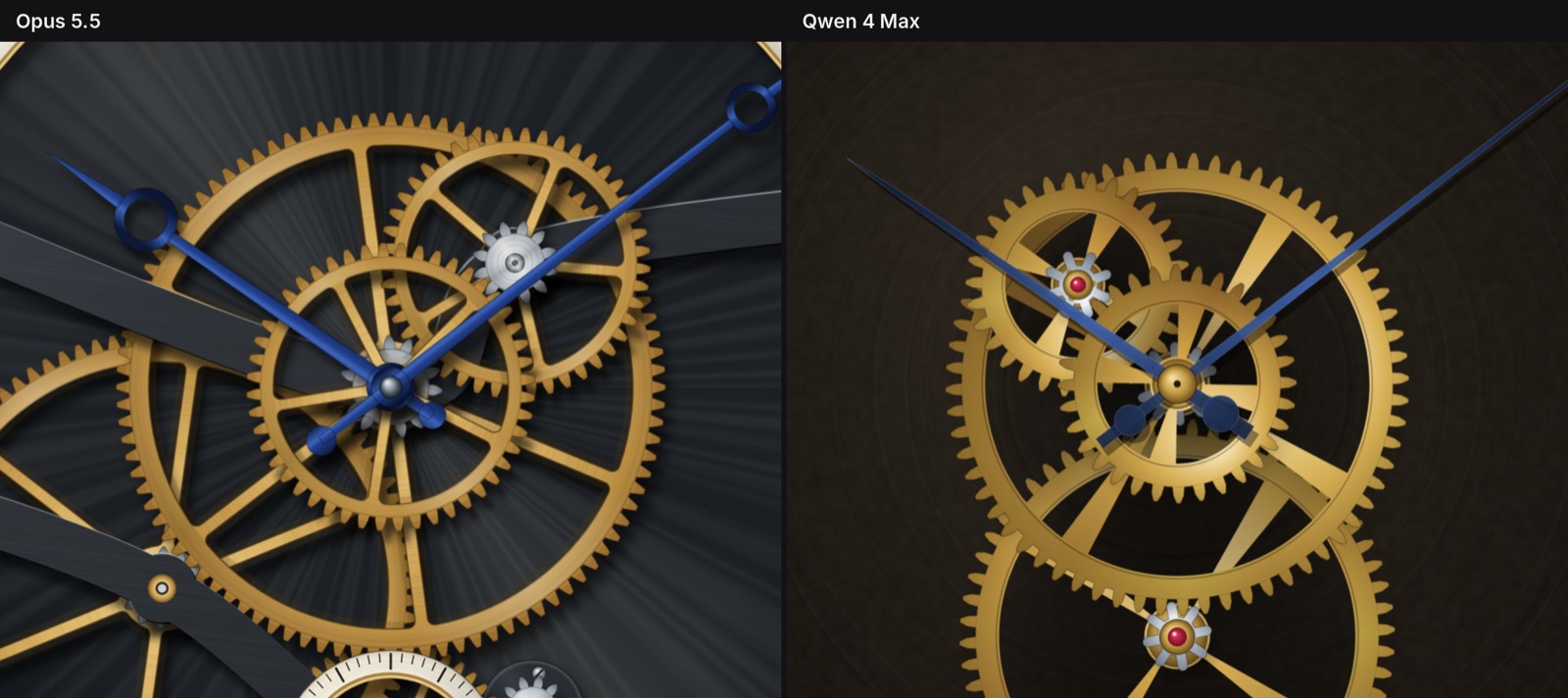
Opus also built a frame with bridges and pillars, and checked 47 clearances between gears, shafts and pillars. Qwen has no frame, so one of its wheels sits on a stud attached to nothing. Bolt it to the back plate and it'd pass through the centre wheel. Qwen's inspect labels also sit on top of the gears and hide the hour hand, which is a bold choice for a clock.
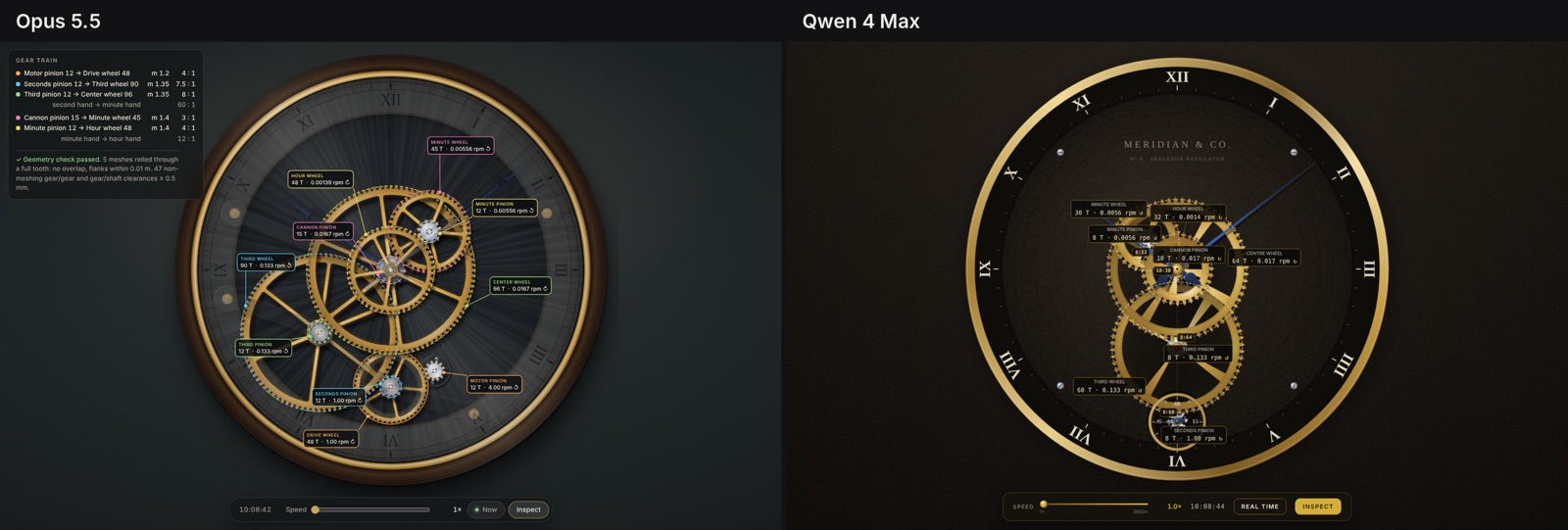
Opus took 50 minutes and $9.19. Qwen took 19 minutes and about 79 cents. Opus wins, and you can see what the extra money bought. Whether you needed it is a fair question.
Test 2: a self-referential quiz
A ten-question multiple-choice quiz where the questions are about the answer key itself, and a prompt asking for "the" answer key. The trap is that there are exactly two valid keys. A model that stops at the first solution fails.
Neither fell for it. Both wrote an exhaustive Go solver over all 9,765,625 combinations, both reported both keys, and both said plainly that there's no single answer. Qwen's write-up mentions a second Python verifier that isn't anywhere in the folder, so I couldn't check that claim. Minor, but I noticed.
A tie. The trap didn't separate them.
Test 3: a feature-flag service with planted requirements
This is my favourite of the three. The spec for a small Go feature-flag service comes with seven requirements. Three are plainly bad ideas: build it as Kafka microservices, decide rollouts randomly on every evaluation, hard-code the admin key. Two are fine. Two are debatable: audit every single evaluation, and write no tests. The point is to see whether the model pushes back or just types.
Both pushed back on the bad ones and shipped a single binary, deterministic rollouts and a generated admin key. They split on the debatable calls. Opus wrote 12 tests anyway. Qwen followed the no-tests rule under protest and wrote none.
Then I ran the same black-box script against both services, and Qwen's has a real bug.
Each flag on its own is fine. At a 25% rollout, 24.85% of 10,000 users got the flag, and nobody flipped between requests. But two flags at 50% should share about 25% of users. With Opus's SHA-256 bucketing, 153 flag pairs landed between 24.35% and 25.75%. With Qwen's FNV-1a hash and 100 buckets, the overlap ran from 12.8% to 31.6% depending on the flag names.
The cause is the hash. FNV-1a never mixes its high bits down into the low ones, and taking the result modulo 100 leans on those low bits. One consequence: whether a user's bucket is odd or even under one flag tells you which it'll be under every other flag. None of this matters until you run two experiments at once, and then your results are quietly skewed.
Here's the repro if you want to see it yourself:
import hashlib, itertools

def qwen_bucket(flag, user):          # FNV-1a 64 over flag + "\0" + user, mod 100
    h = 0xcbf29ce484222325
    for b in flag.encode() + b"\0" + user.encode():
        h = ((h ^ b) * 0x100000001b3) & 0xFFFFFFFFFFFFFFFF
    return h % 100

def opus_bucket(flag, user):          # SHA-256(flag + ":" + user), first 8 bytes, mod 10000
    return int.from_bytes(hashlib.sha256(f"{flag}:{user}".encode()).digest()[:8], "big") % 10000

flags = ["f1", "f2", "new-checkout", "new-checkout-v2", "dark-mode", "dark-mode-2", "search.v2", "search.v3",
         "billing_new", "billing_old", "a", "b", "beta", "beta2", "exp-001", "exp-002", "exp-003", "exp-004"]
users = [f"user-{i}" for i in range(20000)]

for name, bucket, half in (("qwen", qwen_bucket, 50), ("opus", opus_bucket, 5000)):
    on = {f: {u for u in users if bucket(f, u) < half} for f in flags}          # every flag at 50%
    overlap = [100 * len(on[a] & on[b]) / len(users) for a, b in itertools.combinations(flags, 2)]
    print(f"{name}: {len(overlap)} pairs, overlap {min(overlap):.2f}% to {max(overlap):.2f}% (expected about 25%)")
qwen: 153 pairs, overlap 12.80% to 31.59% (expected about 25%)
opus: 153 pairs, overlap 24.35% to 25.75% (expected about 25%)A few more things in Qwen's version. Every evaluation writes its audit row synchronously before answering, so if that insert fails (a full disk, say), every flag check returns a 500. Qwen defends this in its decision notes as keeping the audit guarantee honest, which I respect as an argument and still wouldn't ship. A typo in a JSON field name silently creates a flag with defaults. And throughput was roughly a quarter of Opus's on the same box.
Opus, meanwhile, added a change history, an in-memory cache, a health endpoint, security headers, and tests it verified by breaking the code on purpose. That's more than I asked for, and a good part of why it took 18.5 minutes against Qwen's 7.8.
Opus wins this one clearly.
Speed, tokens and cost
Why Qwen finished first
Across all three tasks, Qwen needed 29 minutes and Opus needed 70. That surprised me, because the published numbers say the opposite. Artificial Analysis calls Qwen 4 Max "very verbose" (127M output tokens on its index run, against a median of 78.6M at launch), and The New Stack's head-to-head had it taking 214% longer than Opus 5.5 on the same tasks.
The explanation is in my token counts. Qwen wrote 141k output tokens in total. Opus wrote 440k, about three times as many. Per token, Qwen wasn't faster at all: roughly 80 tokens a second against 105 for Opus. It finished sooner because it did less.
Opus spent its extra 41 minutes on involute teeth, pillar clearances, tests and security headers. Thoroughness or overkill? Depends on the day.
Two caveats. My Opus time is API duration from Claude Code, which excludes tool run time, while the Qwen figure is, as far as I can tell, wall time from pi. And the two harnesses have different system prompts and tools. Treat the ratio as rough.
What it costs on the API
At Alibaba's list price ($1.50 per million input tokens, $4.50 per million output, $0.075 for cached input), my three Qwen runs come to about $1.16. Claude Code reported $14.82 for the Opus runs. Opus 5.5 lists at $4 and $20, so it's three to four times the price per token before you count that Qwen wrote a third as many.
That $1.16 is an estimate. I ran Qwen through my Token Plan and priced the token counts at list API rates.
Don't expect 13x on your own workload, though. Artificial Analysis measures $3.27 per task for Qwen 4 Max and $10.04 for Opus 5.5, which is about 3x. And GPT-6.1 Sol, which I reviewed in October, undercuts both at $1.27 per task while scoring higher on the same index. (I broke down what AI agents cost per month a few weeks ago.)
What about the Token Plan?
Alibaba also sells Qwen through subscription Token Plans for coding tools, from about $6 to $43 a month. That's the same price bracket as OpenCode Go, which I reviewed earlier this year.
I can't give you a clean cost per task. Alibaba doesn't publish how plan credits convert to tokens, and my own plan is discounted right now, so any number I quoted would be wrong within a month. In my experience it's been good value. One thing from the fine print: the terms don't allow using it as a backend for your own app.
Who should use Qwen 4 Max
Use it if you pay API prices and run a lot of agent or batch work, where a few minutes of latency doesn't hurt. It's also good at front-end work: it debuted at #6 on Code Arena's WebDev board before settling at #9. And on Alibaba's own launch chart it leads the legal-agent benchmark by a wide margin, 21.3 against 9.2 for Opus 5.5.
Skip it if you already pay for a Claude plan. Opus is then effectively free at the margin, and it's the better model. I'd skip it for terminal-heavy and whole-repository work too. On that same launch chart Qwen scores 48.5 on Terminal-Bench 4.0 against 59.6 for Opus, and 31.5 on ProgramBench against 65.0. When the vendor's own chart shows a gap that size, believe the chart.
And that's the real problem with Qwen 4 Max. It's a great model, and the competition is too good. Artificial Analysis puts it at 43 on its Intelligence Index, with Opus 5.5 at 59 and Claude Fable 5.2 at 65. A clear step up from 3.8 Max doesn't count for much when everyone else took a step as well.
The Qwen 4 I'm actually waiting for
The Max model gets the headlines, but it was never the reason I follow Qwen. The small models are.
As I write this, there are no open Qwen 4 weights. Alibaba named four tiers on stage in September (Max, Plus, Flash and 27B) and has said the smaller ones will be open. No dates. You'll find articles and forum posts promising the 27B within two or three weeks, and none of them trace back to Alibaba, so I'm treating every date as a rumour until there's a repo to clone.
I can't wait, though. Qwen3.8-27B was already very good, and if the Qwen 4 generation brings the small models the same jump it brought Max, local AI gets close to the point where it can do almost everything.
The catch is hardware. Everything is expensive right now. It doesn't matter whether you want a Mac Studio, a gaming PC with an Nvidia card or one of Nvidia's Spark boxes, you pay more than you used to. But the maths changes as the models improve. If a machine under your desk can do most of what an API does, the money starts to look well spent, especially for business use.
Next on my list is Gemini 4 Neon, the model everyone is talking about. Hopefully I'll find the time for that one soon.
Related Articles
Qwen3.8-Max Review: I Tested Alibaba's 2.4T Model
I ran Alibaba's new 2.4T Qwen3.8-Max-Preview through 4 real coding tests. Results rival Fable 5 and Grok 4.5 — with one big catch: speed.
8 min read
AI NewsGPT-6.1 Sol review: 3 tests vs Opus 5.5 and Grok 4.7
GPT-6.1 Sol review: hands-on tests vs Opus 5.5 and Grok 4.7 on web design and hard Go coding. Near-Opus quality at half the price, but slow.
15 min read
AI NewsClaude Sonnet 5.5 Review: I Tested It Against Opus 5.5
Claude Sonnet 5.5 review: I tested it against Opus 5.5 and Sonnet 5 on a web design and a Go chess engine. Real costs, results, and who should use it.
14 min read